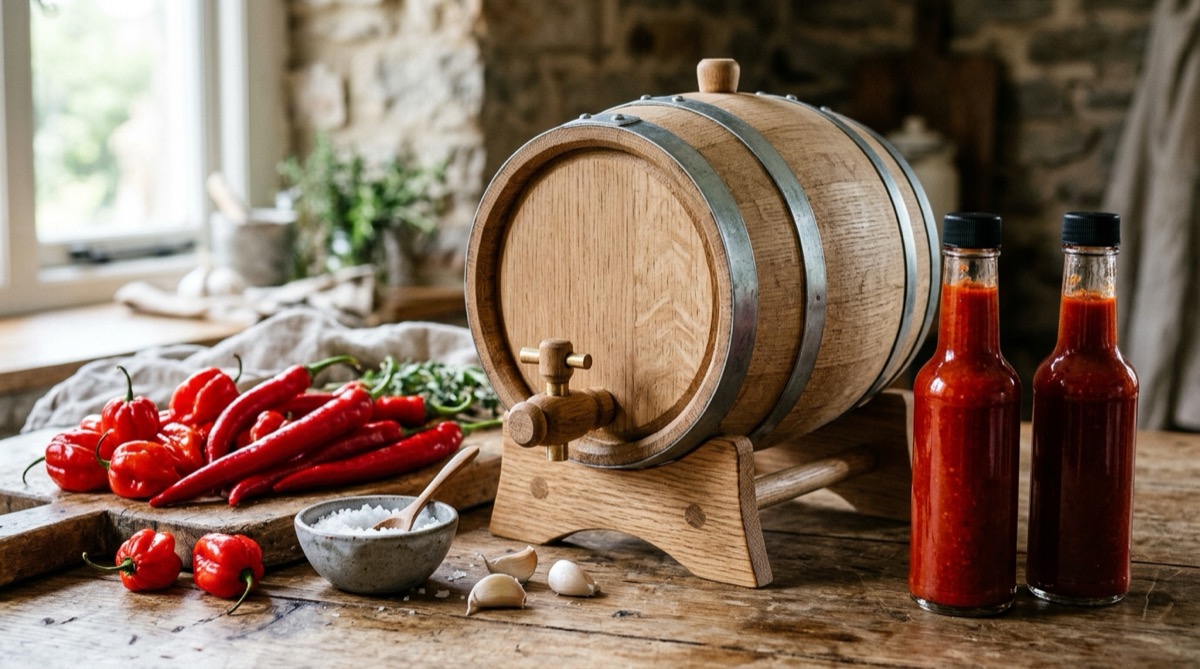
For more than a century and a half, the world’s benchmark craft hot sauces have owed their depth not to vinegar alone, but to slow lactic acid fermentation of salted chili mash inside white oak fermentation barrels. Fermenting peppers in sealed glass jars traps sulfurous gases and leaves raw capsaicin sharp on the throat. Inside a breathable Canadian white oak barrel, gentle stave gas exchange and natural wood tannins round aggressive chili heat into savory, complex umami acidity.
Whether you are crafting two dozen bottles from a backyard pepper harvest in a 5L Open-Top Oak Pickle & Fermentation Barrel ($115) or scaling commercial farmers’ market batches in 20L ($220) and 30L ($255) oak casks, precise salt-by-weight math and pH verification guarantee clean, repeatable batches every season.
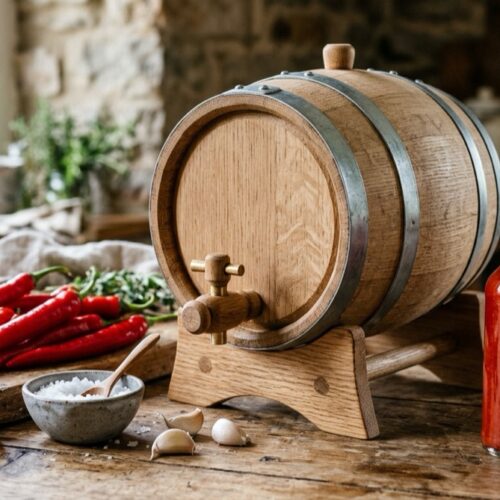
Oak-Barrel Lacto-Fermented Red Chili Hot Sauce
Equipment
- BarrelsWood 5L Open-Top Oak Pickle & Fermentation Barrel with fitted hardwood press lid
- Food processor, nitrile gloves, and digital gram scale for exact 4% salt-by-weight pepper mash
- Calibrated digital pH meter and high-speed blender target finished pH below 3.6
Ingredients
- 1 BarrelsWood 5L Open-Top Canadian White Oak Fermentation Barrel water-cured 48 hours and scalded clean
- 2.4 kg fresh ripe red Fresno or red jalapeño peppers 5.3 lbs — stems removed, sweet-fruity base flesh
- 900 g fresh red cayenne peppers 2 lbs — stems removed, classic bright mid-palate heat
- 300 g fresh red or orange habanero peppers 10.5 oz — stems removed, floral high heat
- 140 g peeled fresh garlic cloves 5 oz
- 150 g fine additive-free non-iodized sea salt 4.0% of total pepper + garlic weight mixed into mash
- 35 g coarse sea salt sprinkled over cabbage leaf / parchment barrier under oak press lid as surface salt cap
- 1.2 L raw apple cider vinegar or white wine vinegar (5% acidity) 5 cups — blended in AFTER oak fermentation completes
- 3.5 g food-grade xanthan gum 1 tsp — optional, prevents pulp separation in bottles
Instructions
- Fill your 5L open-top Canadian white oak fermentation barrel with cold non-chlorinated water for 48 hours until staves swell watertight. Drain, rinse briefly with freshly boiled water to sanitize the surface grain, and allow to cool completely.
- Wearing nitrile gloves, destem (do not deseed) all washed peppers and weigh them together with the peeled garlic (3,740 g total). Pulse in batches in a food processor with 150 g fine non-iodized sea salt until coarsely ground like relish — avoid pureeing into liquid so CO2 bubbles escape smoothly without heaving the mash.
- Press the salted chili mash firmly into the oak barrel with a clean wooden tamper to eliminate air pockets, leaving 4 cm headspace. Lay a clean outer cabbage leaf or trimmed food-grade parchment circle flat across the mash, place the fitted oak press lid on top with a clean stone weight, and sprinkle 35 g coarse sea salt around the perimeter rim to block surface Kahm yeast.
- Rest the barrel in a shaded cellar or pantry at 18–22°C (64–72°F). Active lactic acid bacteria (Lactobacillus plantarum) will bubble vigorously during Days 3–10, dropping mash pH below 4.0 while uncharred white oak staves micro-oxygenate and mellow sharp capsaicin edges over 8 to 12 weeks.
- Remove the weight and top barrier, transfer the fermented oak-aged mash to a high-speed blender with 1.2 L apple cider or white wine vinegar, and blend silky smooth (strain through a fine-mesh chinois for a thin Louisiana-style table sauce, or keep pulp for a thick craft sauce). Shear in 3.5 g xanthan gum while blending if desired, verify pH sits between 3.2 and 3.6 on a digital pH meter, pasteurize gently at 82°C (180°F) for 10 minutes to halt bottle carbonation, and funnel hot into sterilized 150 ml woozy bottles.
Notes
Mash Fermentation vs. Brine Fermentation: Why Oak Prefers Salted Mash
Home cooks starting in glass jars usually submerge whole halved peppers in watery salt brine, which dilutes flavor when blended. Commercial barrel hot sauce makers grind fresh ripe chilies directly with dry non-iodized sea salt into a thick pepper mash. Within hours, osmotic pressure draws natural juice out of the pepper cell walls to form a self-brining slurry concentrated with 100% pure chili flavor.
In an open-top BarrelsWood white oak crock, the fitted hardwood press lid and stone weight keep the dense solids submerged beneath that concentrated crimson brine while natural oak ellagitannins suppress spoilage microbes and stabilize vivid red carotenoid pigments.
Salinity & Barrel Sizing Reference (Home Harvest to Small-Batch Commercial)
| Fermentation Window | Recommended Salt % by Weight | Ideal Oak Barrel Model | Fresh Peppers Capacity | 150 ml Bottle Yield |
|---|---|---|---|---|
| 30 to 60 Days (Bright & Fruity) | 3.5% non-iodized salt | 3L Open-Top Oak Barrel ($105) | 2.2 kg (4.8 lbs) | 14–16 bottles |
| 60 to 120 Days (Balanced Umami) | 4.0%–4.5% non-iodized salt | 5L Open-Top Oak Barrel ($115) | 3.6 kg (8.0 lbs) | 22–26 bottles |
| 4 to 9 Months (Deep Cellar Aged) | 5.5%–6.5% non-iodized salt | 10L Open-Top Oak Barrel ($199) | 7.5 kg (16.5 lbs) | 48–55 bottles |
| 6 to 18 Months (Commercial Reserve) | 7.0%–8.5% non-iodized salt | 20L Open-Top Oak Barrel ($220) | 15.5 kg (34 lbs) | 100–115 bottles |
Food-Safety Checklist: Preventing Kahm Yeast & Exploding Bottles
- Never Add Vinegar Before Lacto-Fermentation: Acetic acid inhibits lactic acid bacteria if added on Day 1. Ferment peppers strictly with non-iodized salt first so Lactobacillus consumes the natural pepper sugars, then blend with vinegar at the end.
- Verify Shelf-Stable Acidity Below pH 3.8 (Target 3.2–3.6): Commercial shelf-stable acidified sauces must sit safely below pH 4.6 (and below pH 3.8 for crisp flavor stability). Test every blended batch with a calibrated digital pH meter rather than paper strips.
- Pasteurize at 82°C (180°F) If Storing Unrefrigerated: Raw probiotic hot sauce is delicious kept in the fridge, but any residual sugars or fruit additions (mango, peach, pineapple) added at blending will restart fermentation in sealed glass woozy bottles at room temperature unless held at 82°C (180°F) for 10 minutes before hot-filling.
Frequently Asked Questions
Can I ferment hot sauce in a horizontal bung-hole whiskey barrel instead of an open-top barrel?
Yes, provided you grind the mash thin enough to pour through the bung hole and replace the solid wooden bung with a drilled food-grade silicone stopper and water airlock! Never hammer a solid wooden bung into an actively fermenting pepper barrel, as CO2 gas pressure will blow the bung or spring a stave seam.
What is the white film sometimes seen on top of pepper mash?
A flat, chalky white film with no fuzz is harmless aerobic Kahm yeast caused by oxygen exposure at the top rim. Using a fitted oak follower lid, a clean cabbage-leaf or parchment barrier, and a perimeter salt cap prevents Kahm yeast from forming; if any appears, skim the top centimeter cleanly before blending.
Will hot sauce permanently season my oak barrel with capsaicin?
Yes. Capsaicinoids and garlic oils bind deeply into porous oak staves. Dedicate your hot-sauce barrel exclusively to future chili mashes, spicy kimchi, or Bloody Mary spirit infusions rather than mild sweet wines.
Recommended Canadian White Oak Barrels & Maturation Specifications
All BarrelsWood casks ship insured from our Ontario cooperage across the United States and Canada with a 30-day structural seal warranty:
| Barrel Model & Capacity | Primary Application | Typical Aging / Fermentation Time | Price (USD) |
|---|---|---|---|
| 3L (0.79 gal) Canadian Oak Barrel | Bourbon, Whiskey, Moonshine, Cocktails | 4 to 8 Weeks | $120.00 |
| 5L (1.32 gal) Special Edition Cask | Whiskey, Rum, Brandy, Fruit Wine | 6 to 12 Weeks | $150.00 |
| 10L (2.64 gal) Canadian Oak Barrel | Home Winemaking, Bourbon & Cellar Aging | 3 to 6 Months | $190.00 |
| 20L (5.28 gal) Canadian Oak Barrel | 5-Gallon Carboy Wine Batches & Craft Spirits | 5 to 9 Months | $215.00 |
| 5L Open-Top Oak Pickle Barrel | Lacto-Fermented Kosher Dill Pickles & Sauerkraut | 5 to 14 Days (Brine) | $115.00 |
| 5L Uncharred Oak Vinegar Barrel | Artisanal Red/White Wine & Cider Vinegar | 6 to 10 Weeks | $160.00 |