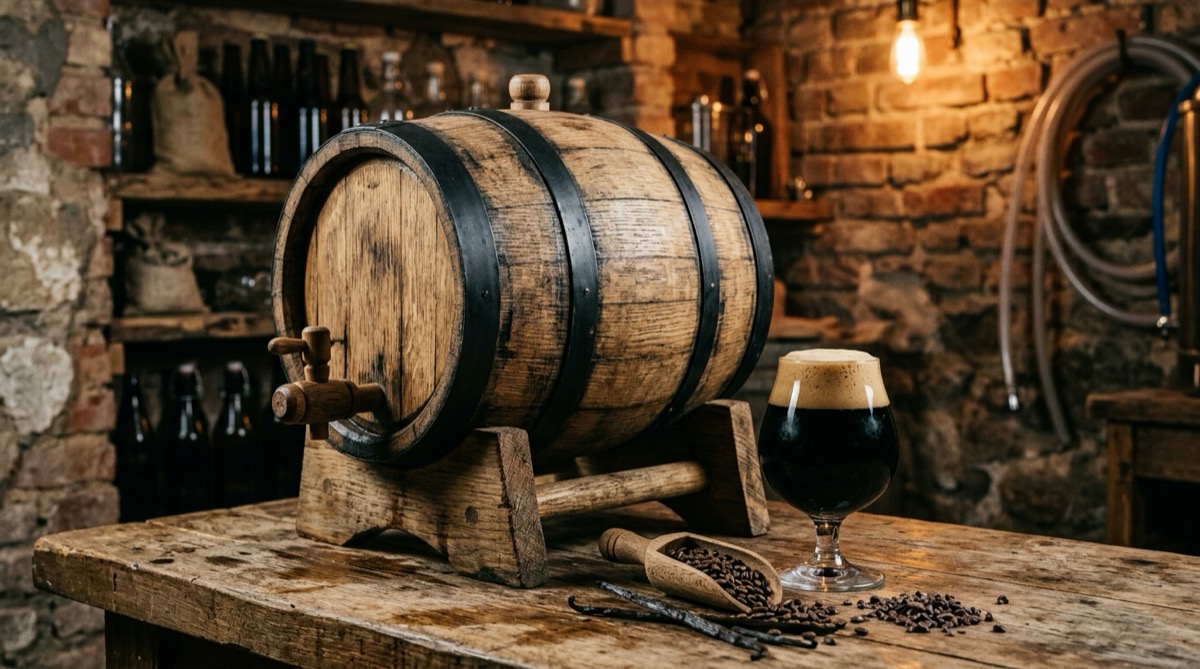
For all-grain and extract homebrewers, our 20L (5.28 US Gallon) Charred Canadian White Oak Barrel ($215) and 20L Special Edition Barrel ($225) are engineered to the exact volume of a standard 5-gallon homebrew fermenter. While commercial craft breweries age stouts for 9 to 14 months in 200-liter distillery barrels, a 20L white oak cask delivers the same deep bourbon warmth, toasted coconut lactones, espresso-vanilla roundness, and velvety micro-oxygenation in just 3 to 6 weeks.
Because beer sits at a much lower alcohol strength than 50% ABV whiskey, brewing a barrel-ready Imperial Stout requires three specific adjustments over a regular 5% ABV stout: higher residual body (1.022–1.026 FG) to balance dry wood tannin, 10%+ ABV alcohol armor, and high-proof bourbon stave sanitation before racking.
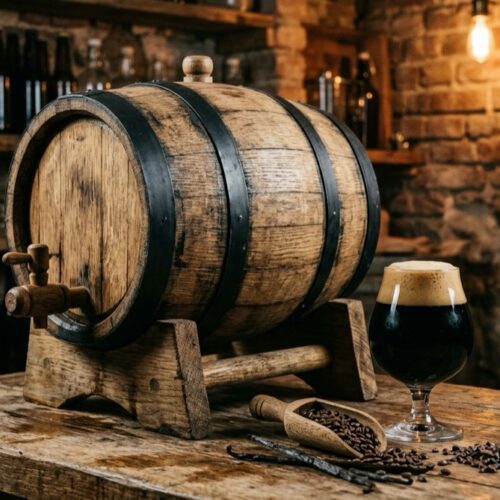
Bourbon Barrel-Aged Imperial Stout (20L / 5-Gallon Cask Batch)
Equipment
- All-grain mash tun & 35L boil kettle (or 25L kettle for extract conversion) target 21L into primary fermenter so 20L clean stout fills barrel
- BarrelsWood 20L (5.28 Gal) Charred Canadian White Oak Barrel water-cured and seasoned with 500 ml bourbon
- CO2 tank or bottling bucket with fresh CBC-1 / EC-1118 conditioning yeast for reliable high-gravity carbonation
Ingredients
- 1 BarrelsWood 20L (5.28 Gal) Charred White Oak Barrel exact match for a standard 5-gallon homebrew batch
- 6.8 kg Maris Otter Pale Ale Malt 15.0 lbs — (Extract brewers: substitute 4.5 kg / 10 lbs Light Dry Malt Extract)
- 680 g Flaked Oats 1.5 lbs — builds silky full-bodied mouthfeel and dense mocha foam
- 550 g Pale Chocolate Malt (200–250°L) 1.2 lbs — dark cacao nib & espresso notes without acrid ash
- 450 g Roasted Barley (300–350°L) 1.0 lb
- 340 g English Dark Crystal Malt (80–90°L) 0.75 lb — dark dried fruit & caramel
- 70 g Magnum or Columbus pellet hops (13% AA — 60 min boil) 2.5 oz — targets ~62 IBU to balance heavy malt & bourbon sweetness
- 2 packets SafAle US-05 or WLP001 California Ale Yeast (rehydrated / 2L starter) clean high-attenuation pitch for 1.104 OG wort
- 500 ml Kentucky Straight Bourbon Whiskey (45–50% ABV) 16.9 fl oz — used to sanitize & bourbon-season the cured 20L barrel; drain excess before racking stout
- 2 whole Madagascar vanilla beans (split and scraped) optional — added for final 7 days of barrel conditioning
Instructions
- Mash the crushed Maris Otter, flaked oats, chocolate malt, roasted barley, and dark crystal in 25 liters of strike water at 68°C (154°F) for 60 minutes to preserve dextrins that stand up to oak tannins. Sparge to collect 27 liters, boil vigorously for 90 minutes adding 70 g Magnum hops with 60 minutes remaining, chill to 18°C (65°F), oxygenate well, and pitch 2 packets of US-05 into 21 liters of 1.104 OG wort.
- Ferment at 18–20°C (65–68°F) for 2 to 3 weeks until terminal gravity stabilizes firmly at 1.022–1.025 (~10.5%–10.8% ABV). Never rack unfinished fermenting stout into a sealed barrel prematurely.
- Five days before racking day, fill your BarrelsWood 20L charred white oak barrel with cold chlorine-free water for 48 hours until watertight, then drain completely. Pour 500 ml of 45%–50% ABV straight bourbon through the bung hole, seal, and roll the barrel 90 degrees twice daily for 72 hours: the high-proof bourbon simultaneously sanitizes the interior wood pores and saturates the char layer. Drain any unabsorbed liquid bourbon right before racking.
- Flush the wet bourbon barrel briefly with CO2 if available, then quietly siphon 20 liters of finished Imperial Stout from the bottom up with zero splashing until beer reaches the bung neck. Fit a drilled silicone stopper and airlock (to vent residual dissolved CO2 safely) and age at 15–18°C (59–64°F).
- Pull a small 20 ml sample weekly starting at Day 14 (add split vanilla beans at Day 21 if desired). In a 20L barrel, toasted oak, dark fudge, and warm bourbon peak between Week 3 and Week 6 on first use. Rack cleanly to a CO2-purged keg to force-carbonate to 2.0–2.2 volumes CO2, OR dose the bottling bucket with 2 g Lallemand CBC-1 cask yeast and 110 g priming sugar (5.5 g/L) before capping heavy glass bottles.
Notes
Why High Final Gravity (1.022–1.026 FG) Prevents Thin, Astringent Barrel Beer
Dry Irish stouts finishing at 1.009 FG taste woody and astringent when aged on new charred oak because there is zero malt sweetness left to buffer extracted oak tannins. Mashing at 68°C (154°F) with 10% flaked oats and pale chocolate malt (instead of excessive acrid black patent malt) leaves rich unfermentable dextrins that wrap around charred oak vanillin and bourbon heat like liquid dark chocolate.
Homebrew Barrel Sizing & Maturation Reference (10L to 50L Casks)
| Brewery Barrel Model | Batch Size Match | Bourbon Seasoning Volume | 1st-Fill Beer Contact Window | 355 ml (12 oz) Yield |
|---|---|---|---|---|
| 10L Special Edition ($200) | 2.5 US Gal (Split Batch) | 300 ml bourbon | 10 to 24 days | 27 bottles |
| 20L Oak Barrel ($215) / 20L SE ($225) | 5.0–5.25 US Gal Standard | 500 ml bourbon | 3 to 6 weeks | 54 bottles |
| 30L Special Edition ($300) | 8.0 US Gal Club Batch | 750 ml bourbon | 5 to 9 weeks | 82 bottles |
| 50L Cellar Barrel ($330) | 13.2 US Gal Half-BBL | 1.0 L bourbon | 8 to 16 weeks | 138 bottles |
Sanitation & Oxidation Rules Specific to Beer Barrels
- Never Burn Sulfur Sticks Inside a Charred Bourbon Barrel Used for Beer: Sulfur dioxide gas creates harsh sulfurous compounds with charred carbon and residual whiskey. Rely strictly on clean hot water + a 72-hour 45%–50% ABV bourbon roll (or age a full batch of bourbon/whiskey in your 20L barrel first before transitioning it to stout duty!).
- Use a Drilled Silicone Bung + Airlock, Never Hammer a Solid Bung on Beer: Even fully attenuated 1.024 FG stout releases dissolved CO2 as cellar temperatures shift by 2°C, and a tiny secondary ferment of residual sugars under a solid wooden bung can pressurize the cask.
- Avoid Over-Carbonating Barrel-Aged Stouts: Keep carbonation low and creamy at 1.9 to 2.2 volumes of CO2; sharp 2.7-volume fizz clashes with roasted malt, oak tannin, and bourbon warmth.
Frequently Asked Questions
Can I brew an extract version of this Bourbon Barrel-Aged Imperial Stout?
Yes. Steep the 550 g pale chocolate malt, 450 g roasted barley, and 340 g dark crystal malt (plus 450 g steeped Carafoam in place of mashed oats) in 10 liters of 68°C (154°F) water for 30 minutes, remove the grain bag, stir in 4.5 kg (10 lbs) Light Dry Malt Extract + 500 g maltodextrin, top up to boil volume, and follow the exact hop, yeast, and 20L barrel steps above.
Should I pour extra bourbon into the bottling bucket at packaging?
Usually no — rolling 500 ml of bourbon inside a 20L barrel for 72 hours saturates the staves with 200–250 ml of spirit that infuses naturally into the stout. Taste at packaging first before ever adding extra spirit.
How many beers can I age in one 20L oak barrel?
A single 20L white oak barrel can condition 4 to 6 clean high-gravity stouts, porters, barleywines, and Scotch ales over 2–3 years, and can then retire into an extraordinary perpetual sour/Brettanomyces Flanders Red or Lambic-style solera cask for another 5+ years.
Recommended Canadian White Oak Barrels & Maturation Specifications
All BarrelsWood casks ship insured from our Ontario cooperage across the United States and Canada with a 30-day structural seal warranty:
| Barrel Model & Capacity | Primary Application | Typical Aging / Fermentation Time | Price (USD) |
|---|---|---|---|
| 3L (0.79 gal) Canadian Oak Barrel | Bourbon, Whiskey, Moonshine, Cocktails | 4 to 8 Weeks | $120.00 |
| 5L (1.32 gal) Special Edition Cask | Whiskey, Rum, Brandy, Fruit Wine | 6 to 12 Weeks | $150.00 |
| 10L (2.64 gal) Canadian Oak Barrel | Home Winemaking, Bourbon & Cellar Aging | 3 to 6 Months | $190.00 |
| 20L (5.28 gal) Canadian Oak Barrel | 5-Gallon Carboy Wine Batches & Craft Spirits | 5 to 9 Months | $215.00 |
| 5L Open-Top Oak Pickle Barrel | Lacto-Fermented Kosher Dill Pickles & Sauerkraut | 5 to 14 Days (Brine) | $115.00 |
| 5L Uncharred Oak Vinegar Barrel | Artisanal Red/White Wine & Cider Vinegar | 6 to 10 Weeks | $160.00 |