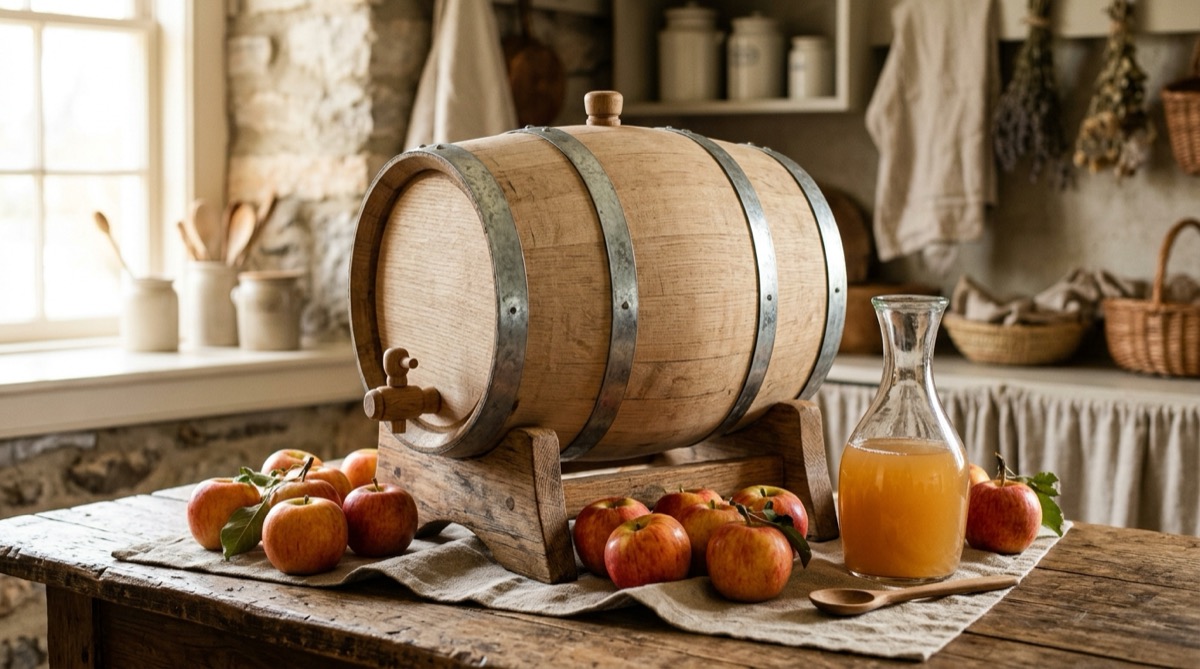
Orchard growers, farm-to-table chefs, and homestead kitchens use dedicated uncharred Canadian white oak vinegar barrels to turn dry autumn hard cider into golden, complex raw apple cider vinegar that bears no resemblance to harsh industrial spirit-diluted vinegars. Built around the classic French Orléans slow-surface method, an uncharred horizontal oak cask provides natural stave breathability, subtle wood honey notes, and a lower wooden spigot positioned cleanly beneath the floating cellulose mother.
Unlike red wine vinegar — which often starts from higher-ABV table wine requiring water dilution — crisp orchard hard cider naturally finishes primary yeast fermentation right in the ideal 6.0% to 7.0% ABV window for direct Acetobacter conversion inside a 5L ($160), 10L ($180), or 20L ($220) BarrelsWood Vinegar Cask.
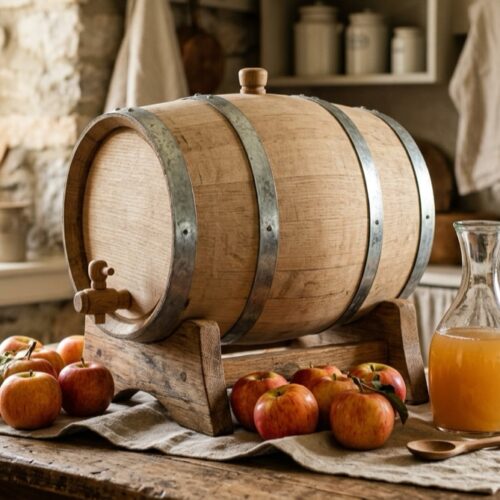
Oak-Aged Raw Unfiltered Apple Cider Vinegar with Live Mother
Equipment
- BarrelsWood 10L Canadian White Oak Vinegar Aging Barrel uncharred acetic cask with wooden spigot & cradle
- 4-layer tight-weave cotton cheesecloth and heavy rubber band breathable bung cover — keeps fruit flies out while admitting oxygen
- Glass acid titration kit or digital pH meter target 5.0%–6.0% acetic acid (pH 2.8–3.2)
Ingredients
- 1 BarrelsWood 10L Uncharred White Oak Vinegar Aging Barrel cured watertight for 48 hours with non-chlorinated water
- 6.5 L dry unpasteurized hard apple cider (6.0%–7.0% ABV, zero potassium sorbate) 1.72 US gal — sulfite-free craft or home-fermented dry cider
- 1.5 L raw unfiltered apple cider vinegar with live Acetobacter mother 50 fl oz — starter inoculum at ~20% of batch volume
Instructions
- Fill your BarrelsWood 10L uncharred white oak vinegar barrel with cool non-chlorinated water for 48 hours until all stave seams swell watertight, then drain completely through the bung hole and spigot.
- Pour 6.5 L dry preservative-free hard cider (6%–7% ABV) and 1.5 L raw unpasteurized apple cider vinegar with live mother into the 10L barrel (8.0 L total liquid). Intentionally leave the top 20% (2.0 L) as open air headspace so aerobic Acetobacter bacteria have maximum liquid surface area to convert ethanol into acetic acid.
- Set the solid wooden bung aside and secure four layers of tight-weave boiled cheesecloth or unbleached linen tightly around the bung collar with a heavy band. Acetobacter requires continuous oxygen exchange while blocking Drosophila vinegar flies.
- Rest the cask in a warm, dark pantry away from wine or beer fermenters. Do not rock or stir the barrel once a gelatinous cellulose pellicle (the vinegar mother) forms across the surface; sinking the mother slows acetic conversion.
- Sample 15 ml from the lower wooden spigot starting at Week 5. Once alcohol aroma disappears and crisp golden apple acidity reaches pH 2.9–3.2 (5%–6% acetic acid), draw off 3 liters into glass bottles from the spigot below the floating mother, then gently funnel 3 liters of fresh dry hard cider down the side wall to keep a perpetual vinegar solera running year-round.
Notes
Why Starting Cider ABV Must Sit Between 5.5% and 7.5%
In aerobic acetic fermentation, Acetobacter aceti oxidizes 1% ethanol into roughly 1% acetic acid by weight (minus minor evaporation). If you pour 12% ABV apple wine straight into a vinegar cask without diluting, high ethanol stuns the starter bacteria or produces an overwhelmingly sharp 10%+ acid concentrate. Conversely, weak 3.5% session cider yields watery vinegar (~3% acidity) that cannot self-preserve at room temperature.
Dry farm-pressed hard cider fermented to 6.0%–7.0% ABV hits the exact biochemical target: zero residual sugar to attract mold, vigorous Acetobacter pellicle growth, and a finished raw orchard vinegar at 5.2% to 6.2% acidity with soft oak-aged roundness.
Orléans Continuous Solera Sizing Table (5L to 20L Vinegar Casks)
| Vinegar Barrel Model | 80% Working Fill Volume | Initial Dry Hard Cider | Live Mother Starter | Monthly Solera Harvest |
|---|---|---|---|---|
| 5L Oak Vinegar Barrel ($160) | 4.0 Liters | 3.25 L (0.86 gal) | 750 ml (25 oz) | 1.5 L every 4–5 weeks |
| 10L Oak Vinegar Barrel ($180) | 8.0 Liters | 6.50 L (1.72 gal) | 1.50 L (50 oz) | 3.0 L every 4–5 weeks |
| 20L Oak Vinegar Barrel ($220) | 16.0 Liters | 13.0 L (3.43 gal) | 3.00 L (101 oz) | 6.0 L every 4–5 weeks |
Starting From Fresh Sweet Orchard Cider Instead of Hard Cider
If pressing fresh autumn Honeycrisp, Russet, or Northern Spy apples (~1.050 specific gravity), complete Stage 1 alcoholic fermentation in a glass carboy or bucket with airlock and a packet of dry cider yeast (such as SafCider or Lalvin EC-1118) for 10 to 14 days until completely dry (1.000 SG, ~6.5% ABV) before transferring into your oak vinegar barrel. Fermenting raw sweet juice and vinegar bacteria simultaneously in one vessel risks ethyl acetate (“nail polish remover”) off-aromas.
Frequently Asked Questions
Why should my vinegar barrel only be filled 75% to 80% full?
Unlike wine aging — which requires zero headspace to prevent oxidation — vinegar bacteria are strictly aerobic. Filling a horizontal cylindrical barrel to 75%–80% exposes a wide ellipse of liquid surface area to fresh oxygen through the cloth-covered bung hole, cutting fermentation time nearly in half.
Why won’t store-bought hard cider start fermenting in my vinegar barrel?
Many mass-market sweet ciders contain potassium sorbate or heavy potassium metabisulfite (sulfites), which inhibit live Acetobacter. Choose preservative-free dry craft cider, or vigorously aerate sulfited cider between two pitchers for 10 minutes and let sit 24 hours before inoculating.
Why does BarrelsWood use wooden spigots instead of brass taps on vinegar barrels?
Acetic acid at pH 2.8–3.2 corrodes brass and copper alloys, leaching metallic salts into your vinegar. Every BarrelsWood vinegar cask ships with a turned 100% hardwood spigot and zero interior metal contact.
Recommended Canadian White Oak Barrels & Maturation Specifications
All BarrelsWood casks ship insured from our Ontario cooperage across the United States and Canada with a 30-day structural seal warranty:
| Barrel Model & Capacity | Primary Application | Typical Aging / Fermentation Time | Price (USD) |
|---|---|---|---|
| 3L (0.79 gal) Canadian Oak Barrel | Bourbon, Whiskey, Moonshine, Cocktails | 4 to 8 Weeks | $120.00 |
| 5L (1.32 gal) Special Edition Cask | Whiskey, Rum, Brandy, Fruit Wine | 6 to 12 Weeks | $150.00 |
| 10L (2.64 gal) Canadian Oak Barrel | Home Winemaking, Bourbon & Cellar Aging | 3 to 6 Months | $190.00 |
| 20L (5.28 gal) Canadian Oak Barrel | 5-Gallon Carboy Wine Batches & Craft Spirits | 5 to 9 Months | $215.00 |
| 5L Open-Top Oak Pickle Barrel | Lacto-Fermented Kosher Dill Pickles & Sauerkraut | 5 to 14 Days (Brine) | $115.00 |
| 5L Uncharred Oak Vinegar Barrel | Artisanal Red/White Wine & Cider Vinegar | 6 to 10 Weeks | $160.00 |