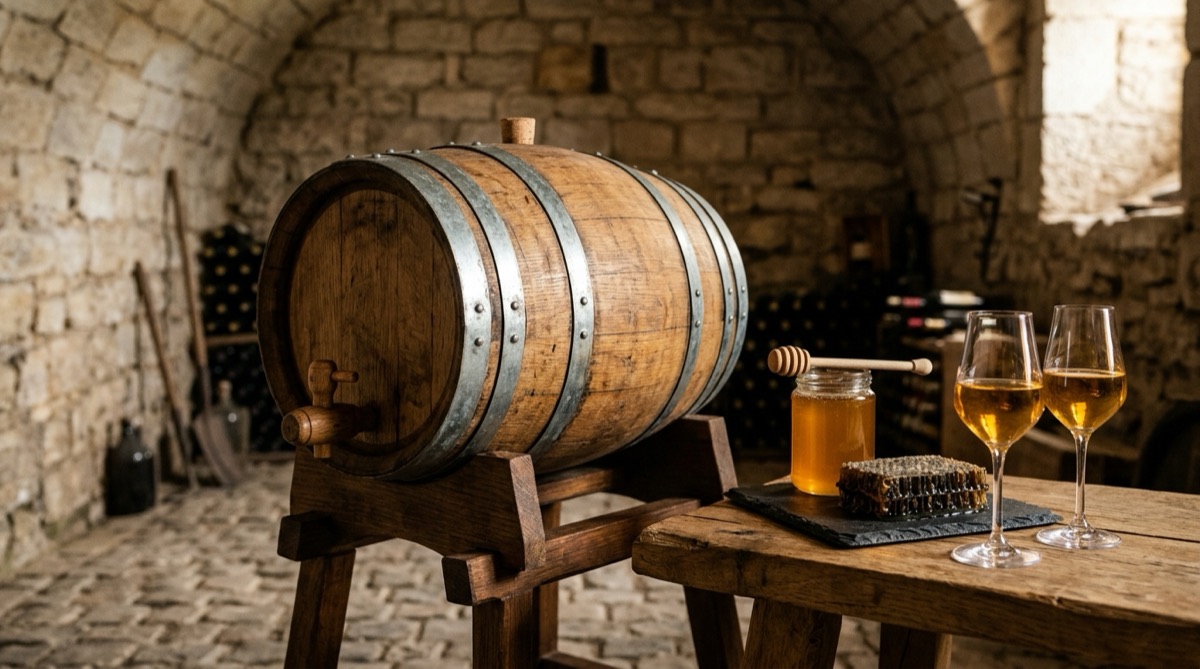
Young traditional mead fermented solely from honey, water, and yeast often suffers from two structural gaps right out of a glass carboy: thin mid-palate tannin (since honey lacks grape skins) and sharp alcohol heat that can take a full year in glass bottles to mellow. Maturing clarified mead inside a Canadian white oak wine barrel solves both challenges in weeks rather than years.
Through slow micro-oxygenation across quarter-sawn Quercus alba staves and gentle extraction of toasted oak ellagitannins and vanillin, a dry 13% ABV wildflower mead develops the lush mouthfeel of a barrel-fermented white Burgundy alongside warm toasted honeycomb aromatics. Our 10-liter batch below fits a 10L Canadian White Oak Wine Barrel ($190) with zero wasted headspace and scales directly to 5L, 15L, and 20L cellar casks.
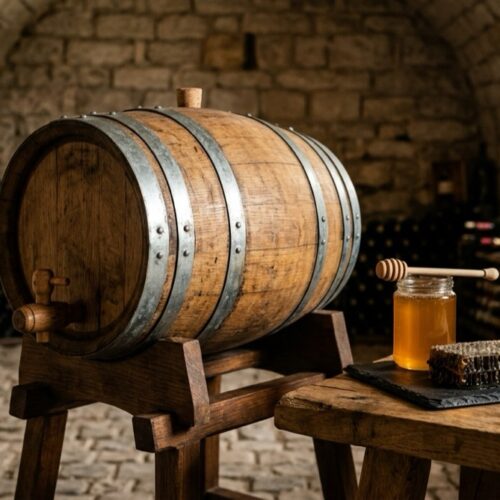
Oak-Barrel Aged Traditional Wildflower Honey Mead
Equipment
- 12L food-grade primary fermenter with airlock and hydrometer for clean primary fermentation off lees before barrel entry
- BarrelsWood 10L Medium-Toast Canadian White Oak Wine Barrel water-cured 48 hours until watertight
- Auto-siphon, wine thief, and thirteen 750 ml corkable glass wine bottles sanitized
Ingredients
- 1 BarrelsWood 10L Canadian White Oak Wine Aging Barrel cured watertight, zero headspace fill
- 3.6 kg raw unpasteurized wildflower or orange blossom honey 8.0 lbs — never boil raw honey; targets ~1.102 OG (13.2% ABV)
- 8.2 L chlorine-free spring water 2.16 US gal — brings primary must to 10.6 L so 10.0 L clean mead racks off lees into the barrel
- 10 g Lalvin 71B or Lalvin D47 wine yeast (2 packets) rehydrated in 12.5 g Go-Ferm at 40°C (104°F)
- 14 g Fermaid O organic yeast nutrient divided into 4 equal 3.5 g doses at 24h, 48h, 72h, and 1/3 sugar break
Instructions
- Warm 2 liters of spring water to 38°C (100°F) — never boil, which drives off delicate floral honey volatiles — stir in 3.6 kg raw honey until dissolved, and top up with cool spring water in your sanitized primary fermenter to 10.6 liters total (approx. 1.102 Original Gravity). Pitch Lalvin D47 or 71B rehydrated in Go-Ferm once must sits at 19–21°C (66–70°F).
- Because pure honey lacks nitrogen, degas gently and stir in 3.5 g Fermaid O at 24 hours, 48 hours, 72 hours, and Day 5. Ferment at 18–20°C (64–68°F) for 3 to 4 weeks until gravity stabilizes near 1.000–1.004 (~13% ABV), then cold-crash or rack into a secondary carboy for 14 days so heavy yeast lees drop out before touching oak.
- Forty-eight hours before racking, fill your BarrelsWood 10L oak wine barrel completely with cool chlorine-free water until watertight, then drain thoroughly.
- Gently siphon 10.0 liters of clarified young mead into the oak barrel right up to the bung neck (zero air headspace prevents oxidation at 13% ABV) and seal with the oak bung or a breathable silicone fermentation bung. Reserve any extra 300–500 ml in a sanitized stoppered bottle in the fridge for topping up evaporation.
- Store at cellar temperature (13–17°C / 55–63°F), topping up 60–90 ml every 3 weeks as needed. Sample every 2 weeks starting at Week 4: medium-toast Canadian white oak builds mid-palate tannin structure, honeyed vanilla, and toasted brioche notes within 6 to 12 weeks on a first fill. Stabilize with potassium metabisulfite (and potassium sorbate only if back-sweetening with 250 g raw honey), siphon into 750 ml bottles, and cork.
Notes
Why Primary Fermentation Belongs in Carboys — and Secondary Maturation Belongs in Oak
Unless you are intentionally barrel-fermenting sur lie with weekly bâtonnage in a 50L–225L barrique, fermenting raw honey must directly inside a small 5L or 10L barrel deposits thick yeast sediment across the bottom staves, making cleanup harder and muting clean oak extraction. Completing vigorous primary fermentation with staggered organic yeast nutrients (Fermaid O) for 3 weeks first — then racking crystal-clear 13% ABV mead into your cured BarrelsWood cask — keeps the interior staves pristine across 6 to 10 consecutive vintages.
Mead Batch Scaling & First-Fill Aging Windows (5L to 20L Casks)
| Wine Barrel Capacity | Raw Honey Needed (13% ABV) | 750 ml Bottle Yield | 1st-Fill Oak Aging Window | 2nd/3rd-Fill Aging Window |
|---|---|---|---|---|
| 5L Oak Cask ($150) | 1.8 kg (4.0 lbs) | 6.5 bottles | 3 to 6 weeks | 2 to 4 months |
| 10L Oak Wine Barrel ($190) | 3.6 kg (8.0 lbs) | 13 bottles | 6 to 12 weeks | 3 to 6 months |
| 15L Oak Wine Barrel ($180) | 5.4 kg (12.0 lbs) | 20 bottles | 8 to 14 weeks | 4 to 8 months |
| 20L Carboy-Sized Barrel ($215) | 7.2 kg (16.0 lbs) | 26 bottles | 10 to 18 weeks | 5 to 10 months |
Managing Ullage (Angel’s Share) & Barrel Storage Between Meads
- Keep Zero Headspace With a Reserve Bottle: Always prepare 5%–6% extra must in primary so you have a stoppered 500 ml bottle of the exact same mead in the refrigerator to top up the barrel every 3 weeks against natural evaporation.
- Match Honey Varietal to Toast Profile: Delicate orange blossom, clover, and fireweed honeys shine with shorter 4-to-8-week contact in toasted wine casks, while dark buckwheat, chestnut, and caramelized Bochet honeys stand up beautifully to heavily charred bourbon-seasoned barrels.
- Wet Holding Solution Between Batches: If your next mead must isn’t ready the day you bottle, rinse the barrel thrice with cold water and fill with a standard winemaker’s holding solution (1 g citric acid + 2 g potassium metabisulfite per liter of cool water) so the staves stay sterile and swollen.
Frequently Asked Questions
How is aging mead in a real oak barrel different from tossing oak cubes into a glass carboy?
Oak chips and cubes sitting inside a sealed glass carboy dump raw wood tannin rapidly with zero oxygen exchange, often tasting planky or harsh. A real white oak barrel breathes continuously through its staves, binding harsh alcohol molecules with oxygen to build genuine cellar roundness alongside balanced oak spice.
What ABV should mead be before going into an oak barrel?
Aim for 12% to 15% ABV for standard non-carbonated wine-barrel meads. Below 11% ABV, strict sulfite management and zero headspace become even more critical to prevent aerobic spoilage.
Can I age fruit melomels (blueberry, cherry, or blackberry mead) in the same barrel?
Yes. Berry and tart-cherry melomels thrive in medium-toast white oak; simply ferment and press off whole fruit skins in primary before racking clear ruby melomel into the oak cask so fruit seeds never clog the wooden spigot.
Recommended Canadian White Oak Barrels & Maturation Specifications
All BarrelsWood casks ship insured from our Ontario cooperage across the United States and Canada with a 30-day structural seal warranty:
| Barrel Model & Capacity | Primary Application | Typical Aging / Fermentation Time | Price (USD) |
|---|---|---|---|
| 3L (0.79 gal) Canadian Oak Barrel | Bourbon, Whiskey, Moonshine, Cocktails | 4 to 8 Weeks | $120.00 |
| 5L (1.32 gal) Special Edition Cask | Whiskey, Rum, Brandy, Fruit Wine | 6 to 12 Weeks | $150.00 |
| 10L (2.64 gal) Canadian Oak Barrel | Home Winemaking, Bourbon & Cellar Aging | 3 to 6 Months | $190.00 |
| 20L (5.28 gal) Canadian Oak Barrel | 5-Gallon Carboy Wine Batches & Craft Spirits | 5 to 9 Months | $215.00 |
| 5L Open-Top Oak Pickle Barrel | Lacto-Fermented Kosher Dill Pickles & Sauerkraut | 5 to 14 Days (Brine) | $115.00 |
| 5L Uncharred Oak Vinegar Barrel | Artisanal Red/White Wine & Cider Vinegar | 6 to 10 Weeks | $160.00 |